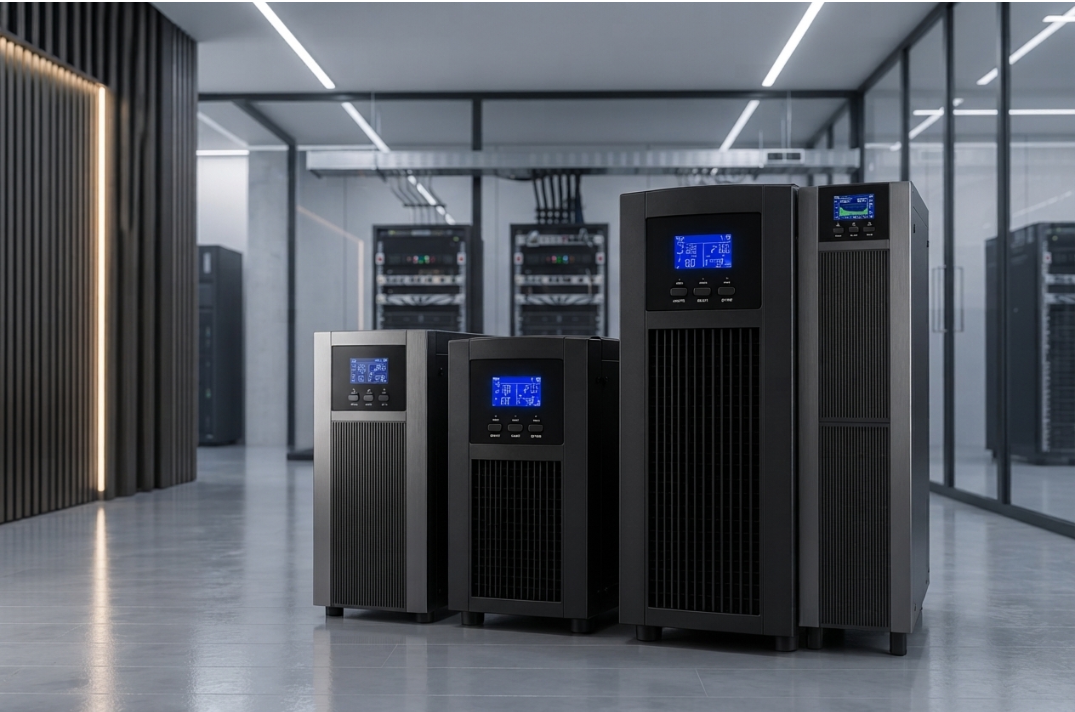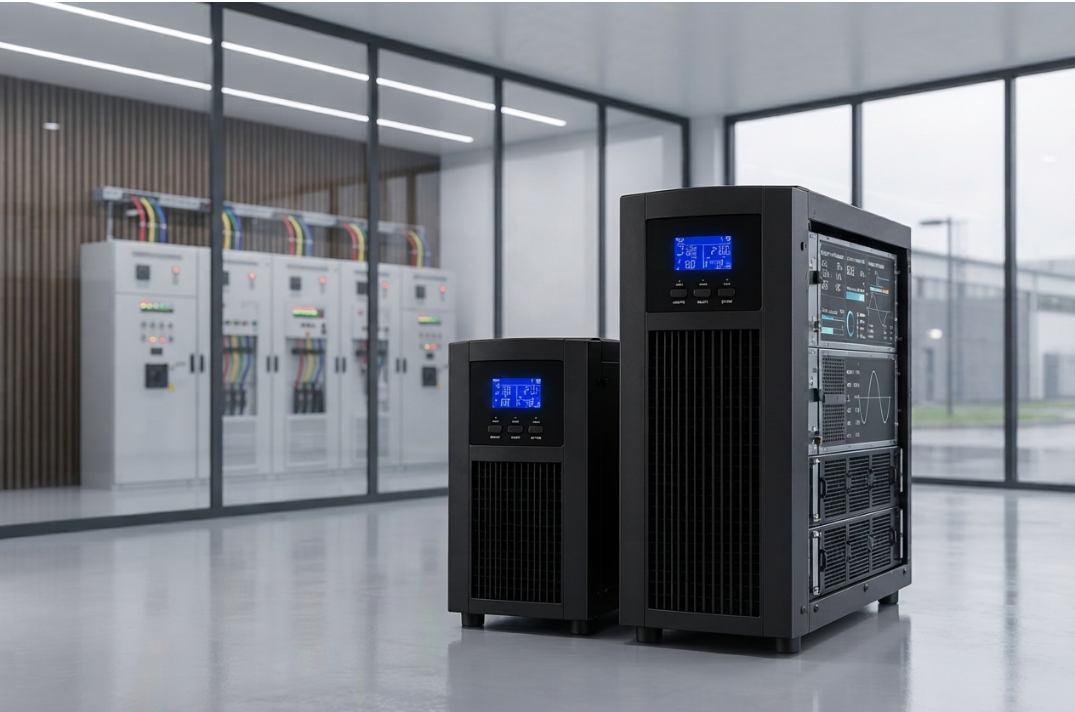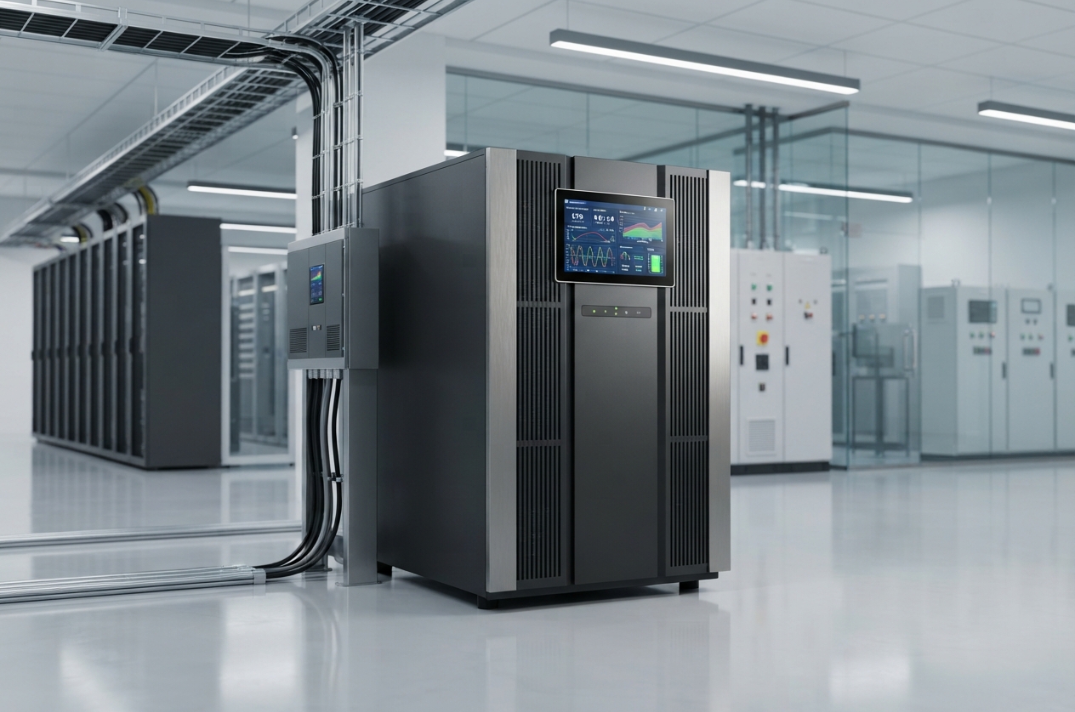

A UPS battery backup time decreases over time because of battery ageing, repeated discharge cycles, high operating temperatures, improper charging, and increasing connected loads. Even when a three-phase online UPS continues to operate normally, its batteries may gradually lose their ability to store and deliver sufficient energy during a power failure. As a result, equipment may shut down earlier than expected, increasing the risk of downtime, data loss, and operational disruption.
Understanding why UPS battery backup time decreases is essential for businesses that depend on continuous power. Therefore, regular battery inspections, correct load management, and preventive maintenance are necessary to maintain reliable backup performance. In this guide, we explain eight common reasons behind reduced UPS battery runtime and discuss practical steps to address each issue.
1. Natural Battery Ageing
Battery ageing is one of the most common reasons UPS backup time decreases. As batteries age, their internal chemical reactions become less efficient, and their ability to store usable energy gradually declines. Consequently, an older battery may reach its discharge limit much sooner than a new battery under the same load conditions.
For example, a battery bank that originally supported equipment for 60 minutes may provide considerably less backup after several years of operation. The actual reduction depends on battery chemistry, operating temperature, charging conditions, discharge history, and maintenance quality.
Although a UPS may display normal operating status, that does not necessarily mean its batteries retain their original capacity. Therefore, businesses using a three-phase online UPS should include battery condition assessments in their preventive maintenance schedules.
How to reduce the impact:
- Monitor battery age and manufacturer-recommended service life.
- Perform periodic battery inspections and appropriate capacity tests.
- Replace batteries when their measured performance falls below operational requirements.
- Record runtime measurements to identify gradual deterioration.
2. High Operating Temperature
Temperature has a significant effect on battery performance and service life. In general, elevated temperatures accelerate battery ageing and can shorten the period for which a battery bank remains capable of delivering its rated performance.
This issue is particularly important in server rooms, industrial facilities, and data centres where electrical equipment generates continuous heat. If ventilation is inadequate or the UPS battery room is too warm, battery deterioration may accelerate. As a result, backup time can decline earlier than expected.
For reliable operation, businesses should maintain environmental conditions within the battery manufacturer’s recommended range. In addition, ventilation and cooling systems should be inspected regularly rather than only when a temperature alarm appears.
Facilities planning their critical power infrastructure can also review data centre solutions to understand the importance of coordinated power and environmental management.
How to reduce the impact:
- Maintain the recommended ambient temperature.
- Keep battery ventilation pathways clear.
- Avoid placing batteries near heat-producing equipment.
- Investigate recurring temperature alarms promptly.
3. Frequent Power Failures and Deep Discharges
Every time a UPS switches to battery operation, its batteries discharge. Once utility power returns, the charging system begins replenishing the energy used. However, frequent outages, prolonged power failures, and repeated deep discharges can accelerate battery wear.
The effect depends on battery chemistry, discharge depth, recovery time, and the manufacturer’s operating limits. If outages occur repeatedly before the batteries have fully recharged, the next power failure may begin with less available energy. Consequently, the UPS may provide a shorter backup period.
Businesses operating in areas with unstable electricity supplies should monitor outage frequency and battery recharge behaviour. Where necessary, a correctly sized online UPS system can support critical equipment, but the battery bank must also be designed for the expected outage duration and discharge pattern.
How to reduce the impact:
- Avoid unnecessary battery-powered operation.
- Allow sufficient recharge time between outages.
- Review battery sizing when long or frequent outages are common.
- Investigate whether a generator or another backup source is needed for extended interruptions.
4. Incorrect Battery Charging
A UPS battery requires an appropriate charging process to maintain its condition. Undercharging may leave the battery with insufficient stored energy when another outage occurs. Conversely, unsuitable charging voltage or excessive charging conditions can accelerate degradation, depending on the battery technology and charger design.
Charging problems can arise from incorrect configuration, a faulty charger, damaged connections, or batteries that no longer accept charge efficiently. In some cases, the UPS may return to normal utility operation while the battery bank has not yet recovered enough capacity for the next interruption.
Therefore, it is important to distinguish between insufficient recharge time and a genuine battery or charging-system fault. A qualified technician can check charging voltage, charging current, alarms, battery connections, and manufacturer-specific settings.
Businesses should also review the technical requirements of their power protection systems to ensure that battery configuration and charging arrangements match the intended application.
How to reduce the impact:
- Verify charging parameters against the battery manufacturer’s specifications.
- Check whether the charger is operating correctly.
- Investigate recurring battery or charger alarms.
- Replace damaged batteries and repair defective connections where necessary.
5. Increased Connected Load
UPS backup time depends heavily on the amount of power drawn by connected equipment. When additional servers, networking devices, industrial controllers, or other electrical loads are added, the battery bank must supply more energy per unit of time. Therefore, runtime usually decreases as the total load increases.
For instance, a UPS battery bank that supports a 2,000-watt load for a particular period will generally provide less backup if the connected load rises to 3,000 watts. The exact runtime cannot be calculated from load alone because battery condition, discharge characteristics, UPS efficiency, and operating limits also matter.
This issue often appears after business expansion, equipment upgrades, or changes to IT infrastructure. Consequently, the original battery backup estimate may no longer reflect actual operating conditions.
Before adding equipment, businesses should assess their networking and IT infrastructure requirements and calculate the updated load. It is also important to distinguish between a UPS’s rated power capacity and the energy available from its battery bank; these are related but different design considerations.
How to reduce the impact:
- Measure the actual connected load rather than relying only on nameplate ratings.
- Review UPS utilisation after equipment upgrades.
- Remove non-essential loads from critical backup circuits where appropriate.
- Recalculate the expected runtime whenever the load changes.
6. Poor Battery Connections and Corrosion
Battery performance can also be affected by loose terminals, corroded connections, damaged cables, or excessive resistance in the battery circuit. These conditions can create voltage drops, produce heat, and interfere with the effective delivery of power from the battery bank.
In a multi-battery UPS configuration, a problem affecting one connection or battery may also reduce the performance of the overall bank. Depending on the system design, a weak battery can limit usable capacity or trigger a battery-related alarm.
Visual inspections are useful, but they cannot identify every electrical problem. Therefore, trained technicians should inspect connections, check for abnormal heating, and carry out appropriate electrical measurements while following the manufacturer’s safety procedures.
How to reduce the impact:
- Inspect accessible battery connections at scheduled intervals.
- Check for corrosion, loose terminals, and damaged cables.
- Investigate unusual heating or recurring battery alarms.
- Use qualified personnel for electrical testing and maintenance.
Never disconnect, tighten, or service live battery connections without the required training and safe isolation procedures. UPS battery banks can deliver hazardous fault currents even when utility power is disconnected.
7. A Weak or Failing Battery Within the Bank
A UPS battery bank may contain multiple batteries connected in series, parallel, or a combination of both. Although these batteries operate together, their condition does not always deteriorate at the same rate. One weak battery can therefore affect the performance of the complete bank.
In a series-connected string, the weakest battery may reach its discharge limit before the others. This can reduce the usable energy of the string and may cause the UPS to stop supporting the load earlier than expected. In other configurations, the impact depends on the electrical arrangement and battery management system.
A battery bank should consequently be assessed as a system rather than judged only by its overall voltage. Individual battery measurements, impedance or conductance testing where suitable, and controlled capacity testing can help identify batteries that are underperforming.
Businesses that require continuous power should arrange professional inspections and consider UPS rental options when temporary backup equipment is needed during maintenance, replacement, or system upgrades.
How to reduce the impact:
- Monitor individual battery readings where the system permits.
- Investigate significant differences between batteries.
- Use appropriate battery testing methods.
- Follow manufacturer guidance when replacing batteries within a bank.
8. Incorrect Battery Sizing or Unrealistic Runtime Expectations
Sometimes, the apparent reduction in backup time is not caused by battery deterioration. Instead, the original battery bank may have been undersized for the actual load, or the initial runtime estimate may have relied on ideal conditions that do not match real-world operation.
Battery backup calculations must account for load power, battery voltage, amp-hour capacity, UPS efficiency, usable discharge limits, battery condition, and the manufacturer’s discharge-rate data. Simply multiplying battery voltage by amp-hour capacity gives nominal energy, not the exact amount of usable energy delivered to the load.
For example, a battery bank rated at 240 volts and 100 amp-hours has a nominal energy of 24,000 watt-hours. However, the energy available to connected equipment will be lower after accounting for discharge limitations, conversion losses, battery condition, and load-dependent behaviour. Actual runtime should be estimated using manufacturer data and verified through appropriate testing.
When a business changes its operating requirements, the original battery configuration may no longer be sufficient. Reviewing single-phase UPS options for suitable lower-power applications and assessing the requirements of the overall installation can help ensure the selected architecture matches the load. The final choice should always be based on electrical requirements, not phase configuration alone.
How to reduce the impact:
- Recalculate runtime using measured load data.
- Use manufacturer discharge tables or approved sizing tools.
- Include an appropriate design margin for ageing and operating conditions.
- Reassess battery capacity whenever runtime requirements change.
Warning Signs That UPS Battery Backup Time Is Decreasing
In addition to measuring runtime, businesses should watch for signs that battery performance is deteriorating. These indicators do not always confirm battery failure, but they justify further investigation.
- Shorter runtime: Equipment loses power sooner during an outage than it did previously.
- Battery alarms: The UPS reports a battery fault, reduced capacity, or a charging problem.
- Longer recovery time: The battery bank takes longer than expected to recharge.
- Unexpected shutdowns: The UPS stops supporting the load despite apparently adequate charge.
- Visible damage: Batteries show leakage, swelling, corrosion, or other physical abnormalities.
- Uneven battery readings: Individual batteries show unusual voltage or test-result differences.
If any of these symptoms appear, record the operating conditions and arrange a suitable inspection. Do not assume that replacing the batteries is the only possible solution; a charging fault, overloaded UPS, or defective connection may also be responsible.
How to Maintain UPS Battery Backup Time
A consistent maintenance programme helps businesses identify declining battery performance before it causes an unplanned shutdown. The programme should be tailored to the battery technology, UPS design, operating environment, and manufacturer’s recommendations.
| Maintenance activity | Recommended purpose |
|---|---|
| Monitor UPS alarms and battery status | Identify emerging faults |
| Record actual load levels | Detect increasing power demand |
| Check room temperature and ventilation | Reduce temperature-related degradation |
| Inspect connections and battery condition | Identify corrosion, damage, or loose connections |
| Review charging behaviour | Detect charging-system problems |
| Perform appropriate battery tests | Assess condition and available capacity |
| Review runtime requirements | Confirm that the battery bank remains suitable |
Testing intervals should follow the manufacturer’s guidance and the criticality of the installation. For mission-critical environments, maintenance may need to be more frequent than for non-essential applications.
Additionally, businesses should keep records of battery installation dates, test results, alarms, replacements, and runtime measurements. These records make it easier to distinguish normal ageing from sudden performance changes.
Frequently Asked Questions
1. Why does my UPS battery drain quickly even after charging?
Possible causes include battery ageing, incomplete charging, excessive connected load, high temperature, faulty connections, or a weak battery within the bank. A qualified technician should evaluate the battery and charging system before replacement decisions are made.
2. How many years does a UPS battery last?
Battery life depends on chemistry, operating temperature, charging conditions, discharge history, and maintenance. The manufacturer’s stated service life is a guide, not a guarantee of actual runtime or replacement timing.
3. Can an overloaded UPS reduce battery backup time?
Yes. A higher connected load generally draws energy from the battery more quickly, reducing runtime. An overload may also trigger protection mechanisms or cause the UPS to shut down, depending on the system.
4. Does a new battery always restore the original backup time?
Not necessarily. A new battery may improve runtime if the old battery was the cause, but an excessive load, charging fault, unsuitable battery configuration, or faulty connection can continue to affect performance.
5. How can I calculate UPS battery backup time?
A preliminary estimate can be made using battery energy, load power, and adjustment factors for usable capacity and conversion efficiency. However, the result is approximate. For more accurate sizing, use manufacturer discharge data and consider the actual operating load, battery condition, and UPS specifications.
Conclusion
UPS battery backup time decreases over time for several reasons, including natural battery ageing, high temperatures, frequent discharges, incorrect charging, increased connected loads, poor connections, weak batteries, and unsuitable battery sizing. Identifying the correct cause is essential because each problem requires a different corrective action.
Therefore, businesses should combine regular inspections, load monitoring, suitable battery testing, and accurate runtime calculations to maintain dependable backup performance. Most importantly, do not rely solely on the UPS display or the battery’s age to judge its condition. Actual performance testing and manufacturer guidance provide a stronger basis for maintenance and replacement decisions.
For additional technical information and power protection resources, visit the Bansal Hitech blog.