Introduction
A higher-capacity three-phase UPS upgrade becomes necessary when an organisation expands its IT infrastructure, installs additional machinery, increases server workloads or experiences frequent overload alarms. However, selecting a UPS with a higher kVA rating is not sufficient by itself. The new system must match the actual electrical load, power factor, battery autonomy requirements, available infrastructure and future expansion plans.
An incorrectly planned upgrade can result in unnecessary capital expenditure, inadequate battery backup, electrical compatibility issues or avoidable downtime during installation. Therefore, businesses should evaluate the entire power protection system before replacing their existing equipment.
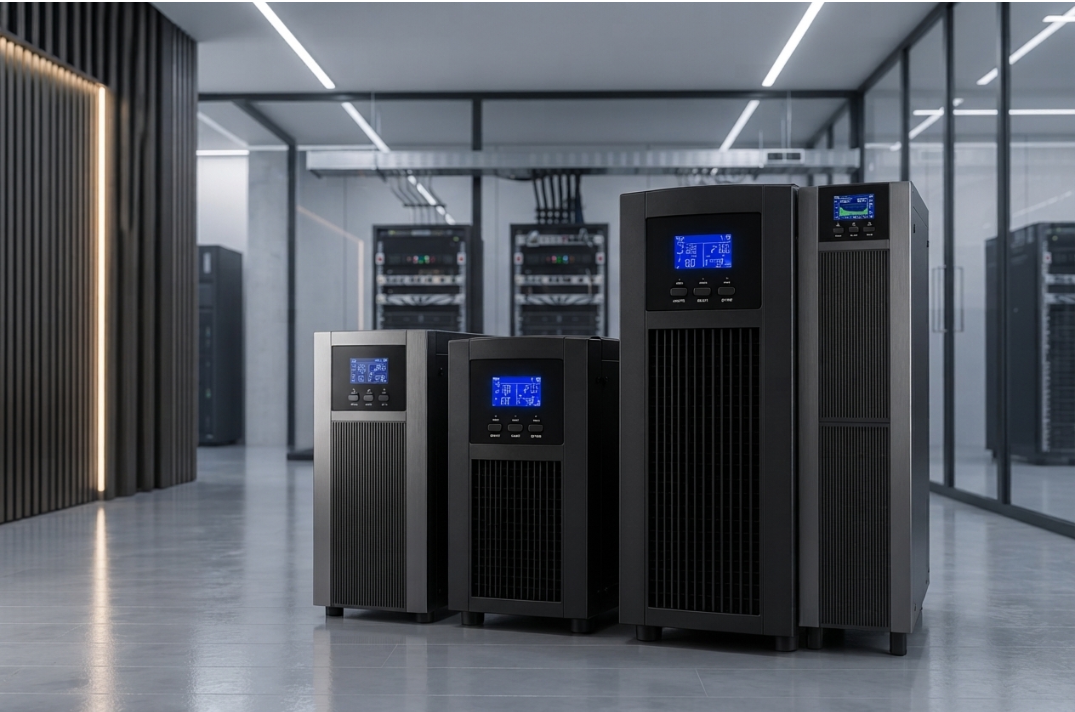
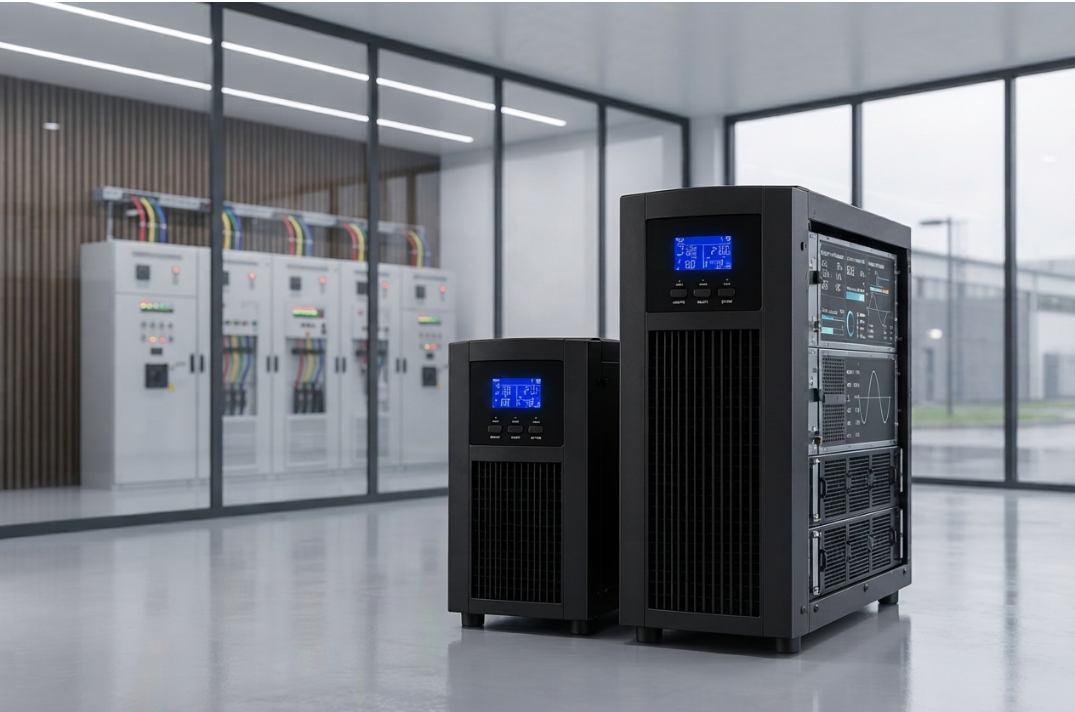
A three-phase uninterruptible power supply (UPS) supports critical loads by providing conditioned electrical power and battery-backed operation when the normal supply fails. Depending on the application, this may include data centres, industrial automation systems, enterprise networks, healthcare facilities and other mission-critical environments.
This guide explains 10 essential checks before upgrading a three-phase UPS, helping facility managers, IT teams and electrical engineers plan a technically sound, safe and scalable solution.
1. Assess Your Existing Electrical Load
The first step in a higher-capacity three-phase UPS upgrade is to establish how much power the existing equipment actually consumes.
Do not determine the required capacity solely from the nameplate ratings of connected devices. Nameplate ratings indicate equipment limits or specified operating characteristics, whereas measured demand helps establish the real load profile.
What should you measure?
- Real power (kW): The power consumed by the connected equipment.
- Apparent power (kVA): The total electrical capacity required from the UPS.
- Power factor (PF): The relationship between real power and apparent power.
- Peak demand: The highest load observed during operation.
- Load variation: Changes in demand throughout the day or production cycle.
- Inrush current: Temporary current increases when particular equipment starts.
Use an appropriately rated power analyser or electrical monitoring system to measure the load under representative operating conditions. Include normal operation, peak production, server utilisation spikes and other foreseeable demand changes.
For example, a facility may operate at 65 kW during normal conditions but reach 85 kW when additional equipment runs simultaneously. Sizing the replacement UPS around the lower figure could leave insufficient headroom.
For businesses reviewing their wider electrical protection requirements, Bansal Hitech’s three-phase online UPS solutions provide a relevant starting point for evaluating available system options.
2. Calculate Both kVA and kW Requirements
A UPS must satisfy both its apparent-power rating and its real-power rating. Checking only one can lead to incorrect sizing.
The relationship between the two is:
kW = kVA × Power Factor
Therefore:
kVA = kW ÷ Power Factor
Suppose the measured critical load is 80 kW and the required UPS operating power factor is 0.9.
Required apparent power:
80 ÷ 0.9 = 88.89 kVA
A UPS rated at 100 kVA and 0.9 output power factor would provide 90 kW of rated real-power capacity. However, this does not automatically mean that the 100 kVA model is the right choice. The engineer must also consider the manufacturer’s output ratings, overload capability, load characteristics, redundancy requirements and future growth.
Check the manufacturer’s output specifications
Before purchasing a replacement system, verify:
- Rated output in kVA and kW.
- Output power factor and compatibility with the intended load.
- Overload duration and percentage limits.
- Crest-factor capability for non-linear loads.
- Derating requirements at the installation temperature or altitude.
- Any restrictions on parallel operation.
For additional context, review Bansal Hitech’s online UPS solutions when comparing UPS architectures and capacity requirements.
Important: Do not use a generic power-factor assumption without checking the actual equipment specifications. The selected UPS must support the expected real and apparent power simultaneously.
3. Plan for Future Capacity Growth
An upgrade should address present demand without forcing another premature replacement. However, excessive oversizing can increase initial expenditure and may affect efficiency, depending on the equipment and operating conditions.
Estimate how the electrical load may change over the expected service life of the UPS.
Consider the following growth factors:
- Additional servers, storage systems and network switches.
- New production lines, motors or automation equipment.
- Increased computing requirements and AI workloads.
- Expansion into additional rooms, floors or facilities.
- Planned business growth and higher operational availability requirements.
For example, if the present critical load is 80 kW and the organisation forecasts an additional 20% demand over its planning period, the projected load would be:
80 kW × 1.20 = 96 kW
The UPS should be evaluated against that projected demand, together with the required reserve margin and all other electrical constraints.
Do not treat forecast growth as an arbitrary percentage. Base it on approved expansion plans, equipment schedules and measured load trends.
Businesses expanding server rooms or critical IT environments should also review data centre solutions to coordinate UPS capacity with the broader infrastructure design.
4. Evaluate Battery Backup Time and Battery Condition
A higher-capacity UPS does not automatically provide longer battery backup. Runtime depends on the connected load, battery configuration, battery condition, discharge characteristics, operating temperature and the UPS’s conversion efficiency.
When planning a higher-capacity three-phase UPS upgrade, establish how long critical equipment must continue operating during a power failure.
Questions to resolve
- What is the required backup duration at the expected load?
- Is the existing battery bank compatible with the proposed UPS?
- Can the batteries deliver the required discharge current?
- Are the battery voltage and battery-string configuration supported?
- Is the battery bank approaching the end of its service life?
- Does the installation require additional battery cabinets or a separate battery room?
- Are the battery monitoring and protection arrangements suitable?
Battery runtime is not always proportional to battery capacity or inversely proportional to load. Battery discharge behaviour is non-linear, and manufacturer runtime data should be used for the intended configuration.
If the battery bank is ageing, undersized or incompatible with the replacement UPS, the project may require a battery upgrade as well.
Review Bansal Hitech’s power solutions when assessing the wider requirements of a critical power installation.
Practical recommendation: Obtain a manufacturer-supported runtime calculation for the specified load and battery configuration. Where appropriate, validate it through controlled testing and a documented battery maintenance programme.
5. Verify the Electrical Infrastructure
A larger UPS can impose different demands on the electrical installation. Before selecting equipment, confirm that the incoming supply, distribution boards, cables, protective devices and earthing arrangements can support the proposed system.
The assessment should be completed by a qualified electrical professional.
Electrical checks before installation
Input supply: Confirm the required input voltage, frequency, phase configuration and allowable supply tolerances.
Cables and conductors: Verify current-carrying capacity, installation method, ambient-temperature derating, voltage drop and short-circuit withstand requirements.
Circuit breakers and protection: Check protective-device ratings, coordination, fault-clearing capability and the manufacturer’s recommendations.
Earthing and bonding: Confirm compliance with applicable electrical codes and the facility’s earthing design.
Bypass arrangements: Verify that the maintenance bypass and static bypass arrangements are suitable for the new UPS and its operating mode.
Short-circuit requirements: Ensure that prospective fault current and protective-device breaking capacity are addressed in the design.
A UPS upgrade may also require changes to the upstream transformer, generator interface, switchgear or downstream distribution equipment. These requirements must be assessed rather than assumed.
For organisations upgrading interconnected IT environments, networking and IT infrastructure solutions can be considered alongside the electrical project to support coordinated infrastructure planning.
6. Check Phase Balancing and Load Compatibility
Three-phase UPS systems supply power through three electrical phases. The way the connected loads are distributed across those phases can affect current levels, system utilisation and overall electrical performance.
This is particularly important where a UPS supplies a combination of three-phase equipment and single-phase loads, such as servers, network devices, workstations and control systems.
What needs to be checked?
- Current on each phase under representative operating conditions.
- Phase imbalance and neutral-conductor loading, where applicable.
- Load distribution across downstream circuits.
- Compatibility with non-linear loads and their harmonic characteristics.
- Starting and transient behaviour of motors or other demanding equipment.
- Compatibility with the UPS output voltage, frequency and waveform requirements.
Do not assume that a three-phase UPS automatically eliminates downstream phase imbalance. The final result depends on the UPS topology, load arrangement and distribution design.
Where single-phase equipment is involved, verify that the selected UPS supports the intended connection arrangement and that no phase exceeds its permitted loading.
A single-phase UPS solution may also be relevant for smaller, separately protected loads, provided the final system architecture is engineered appropriately.
7. Determine the Required Redundancy and Availability
Capacity and availability are different design objectives. A UPS can have sufficient rated output for the connected load yet still lack the redundancy required for a critical application.
Before finalising the upgrade, determine the level of resilience the facility needs.
Common design considerations
N+1 redundancy: The system has enough additional capacity to tolerate the loss of one designated capacity module or unit, subject to the actual design and failure scenario.
Parallel UPS operation: Multiple UPS units may operate together to provide additional capacity or redundancy when the selected equipment and configuration support it.
Maintenance bypass: An appropriate bypass arrangement can permit planned maintenance without interrupting the protected load, provided the electrical design and operating procedures allow it.
Single points of failure: Review batteries, switchgear, distribution paths, cooling, controls and other components that could interrupt the protected supply.
Expansion strategy: Establish whether future capacity should be added through a modular arrangement, parallel UPS units or a later replacement.
The correct design depends on the consequences of downtime. A small office may accept a different level of redundancy from a data centre, hospital or industrial control environment.
Document the required availability target and the failure scenarios the system must withstand before choosing the architecture.
8. Assess the Installation Environment and Physical Space
A higher-capacity UPS may be larger, heavier or have different cooling requirements from the existing unit. The installation environment must therefore be evaluated before equipment is ordered.
Review the following factors:
- Available floor space and equipment clearances.
- Floor loading and structural capacity.
- Ambient temperature and humidity.
- Ventilation and heat rejection.
- Dust, moisture and other environmental contaminants.
- Access for battery replacement and equipment servicing.
- Delivery routes, door openings and lifting requirements.
- Applicable fire protection and battery-room requirements.
UPS systems generate heat during operation. As capacity increases, the facility must be able to accommodate the proposed equipment’s heat output and manufacturer-specified ventilation requirements.
Battery technology also matters. Different battery chemistries have different temperature limits, ventilation considerations, protection requirements and installation constraints.
Check the manufacturer’s installation manual for the exact model rather than applying generic clearance or temperature values.
For projects involving temporary deployment, commissioning or a short-term capacity requirement, online UPS rental options may be worth evaluating against the operational need, provided the rental equipment meets the required electrical and runtime specifications.
9. Plan the Cutover, Testing and Commissioning
Replacing an operating UPS can create downtime if the changeover is not carefully planned. The upgrade should include a documented installation, testing and commissioning strategy before the existing system is disconnected.
Recommended implementation steps
- Document the existing installation: Record the electrical configuration, connected loads, protection settings, battery arrangement and bypass design.
- Prepare the changeover plan: Define responsibilities, shutdown sequences, switching procedures and the approved outage window.
- Confirm the new equipment: Verify the model, output ratings, battery configuration, accessories and site requirements against the approved design.
- Inspect the installation: Check terminations, earthing, cable routing, clearances and other requirements specified by the manufacturer.
- Test the system: Complete the applicable acceptance tests, alarms, bypass functions, monitoring interfaces and operating-mode checks.
- Verify load performance: Confirm that the UPS supports the intended load within its ratings and specified operating limits.
- Validate battery performance: Carry out suitable battery checks and runtime validation in accordance with the approved test plan.
- Document the results: Record test outcomes, settings, exceptions, corrective actions and final acceptance.
Testing should follow the manufacturer’s procedures and applicable electrical safety requirements. Do not perform live electrical work or battery discharge tests without suitable competence, controls and risk assessment.
If the project also involves changes to management platforms or enterprise applications, review relevant software licensing and infrastructure requirements so that associated systems remain supported and operational.
The final handover should include operating instructions, maintenance requirements, alarm escalation procedures, warranty details and updated electrical documentation.
10. Compare Total Cost of Ownership, Not Just Purchase Price
The lowest purchase price does not necessarily represent the lowest long-term cost. A UPS upgrade should be evaluated over its expected operating life, including installation, energy use, maintenance, batteries and future expansion.
Costs to include
| Cost category | What to evaluate |
|---|---|
| Equipment | UPS modules, cabinets, accessories and required options |
| Installation | Electrical work, cabling, switchgear changes and commissioning |
| Batteries | Initial battery bank, monitoring and eventual replacement |
| Energy | Conversion losses and operating efficiency at the actual load |
| Cooling | Additional heat removal and associated facility energy |
| Maintenance | Inspections, service contracts, testing and replacement parts |
| Downtime risk | Business impact of power interruptions and maintenance windows |
| Expansion | Cost and practicality of adding capacity later |
| End of life | Equipment removal and compliant battery disposal or recycling |
UPS efficiency varies by model, operating load, operating mode and system configuration. Compare manufacturer efficiency data at realistic load levels rather than relying exclusively on the highest advertised percentage.
For example, a more efficient UPS may reduce electricity and cooling costs over time. However, the financial benefit should be calculated using the facility’s actual load profile, electricity tariff, operating hours and relevant efficiency data.
Also assess warranty coverage, spare-parts availability, service response and the supplier’s ability to support the installation throughout its expected service life.
A structured comparison of the available power backup and infrastructure solutions can help businesses consider equipment selection alongside long-term support requirements.
External Technical References
When planning a UPS capacity upgrade, use the applicable standards and equipment documentation to validate the engineering design.
- International Electrotechnical Commission (IEC): Consult the relevant IEC publications, including the applicable parts of the IEC 62040 series for uninterruptible power systems.
- U.S. Occupational Safety and Health Administration — Electrical: Review electrical safety information relevant to the work being performed. Applicable Indian regulations and local requirements must also be followed for installations in India.
The exact standard, edition and regulatory requirements should be confirmed for the installation and jurisdiction. These general references do not replace the manufacturer’s instructions or a site-specific engineering assessment.
Conclusion
A successful higher-capacity three-phase UPS upgrade requires more than selecting a unit with a larger kVA rating. Businesses must evaluate actual load demand, real and apparent power, future growth, battery autonomy, electrical infrastructure, phase balancing, redundancy, environmental conditions, commissioning and total cost of ownership.
A systematic assessment helps prevent undersizing, avoid unnecessary expenditure and reduce the risk of disruption during installation. It also creates a clearer basis for selecting a UPS that meets current operational requirements while allowing for planned expansion.
Before approving the project, ensure that the electrical design, battery configuration, installation method and commissioning plan have been reviewed by qualified professionals and are compatible with the manufacturer’s specifications.
For organisations planning a power protection upgrade, Bansal Hitech’s power and infrastructure services can serve as a starting point for exploring related solutions and technical information.