
In today’s digital-first world, businesses heavily depend on their IT infrastructure. From cloud storage and online transactions to customer databases and real-time communication systems, data centers and server rooms are the backbone of every organization.
However, one critical aspect ensures their seamless functioning — uninterrupted power. Even a few seconds of power interruption can lead to data loss, hardware damage, or operational downtime, which may cost thousands (or even millions) of rupees.
That’s where Uninterruptible Power Supply (UPS) systems step in. While many businesses still rely on single-phase UPS systems, data centers and server rooms demand a more robust and efficient power backup — the 3-phase UPS.
In this blog, we’ll explore the top 5 reasons to choose a 3-phase UPS for your data center or server room — and how it ensures maximum uptime, efficiency, and reliability for your IT infrastructure.
What Is a 3-Phase UPS?
Before diving into the reasons, let’s understand the basics.
A 3-phase UPS (Uninterruptible Power Supply) is a power protection system that uses three alternating currents (AC), each out of phase by 120 degrees. This setup allows the system to deliver a constant, balanced, and more efficient power output, suitable for high-capacity electrical loads like those found in data centers and industrial environments.
In contrast, a single-phase UPS is ideal for smaller loads such as desktop computers, routers, or small offices — but it struggles when handling large-scale, continuous power demands.
A 3-phase UPS ensures:
- Stable power distribution
- Higher energy efficiency
- Balanced load sharing
- Reduced stress on electrical infrastructure
Why Data Centers Need 3-Phase UPS Systems
Data centers house hundreds or even thousands of servers, network devices, and cooling systems. These components work simultaneously and require consistent, clean, and stable power.
Power fluctuations, voltage sags, surges, or blackouts can cause:
- Data corruption
- System reboots or failures
- Equipment overheating
- Significant financial loss due to downtime
That’s why a 3-phase UPS is not just an upgrade — it’s a necessity for mission-critical environments like data centers, hospitals, and IT facilities.
5 Key Reasons to Choose a 3-Phase UPS for Data Centers and Server Rooms
1. Superior Power Efficiency and Load Handling
The first and most obvious reason to choose a 3-phase UPS is its power efficiency.
A 3-phase UPS can efficiently handle large electrical loads without overloading circuits or causing instability. It distributes power evenly across three lines, reducing electrical losses and preventing overheating.
Example:
If your data center consumes 60 kVA of power, a single-phase UPS would need an extremely thick cable to handle the current. But with a 3-phase UPS, the current is divided among three lines — significantly reducing the cable size and losses.
Benefits include:
- Higher energy efficiency (up to 96–98%)
- Reduced energy waste and heat generation
- Lower cooling requirements
- Smaller cable size and installation cost
In short:
A 3-phase UPS is smarter, cooler, and more cost-efficient, helping large data centers save on both electricity and maintenance costs.
2. Scalability and Flexibility for Growing IT Needs
Modern data centers are not static — they grow constantly. You might start with a few racks today, but in six months, your infrastructure could double.
A 3-phase UPS system is inherently scalable, allowing you to expand capacity without replacing the entire system. Modular 3-phase UPS designs make it easy to add more power modules or batteries as your load increases.
Key Advantages:
- Modular architecture supports future expansion.
- Hot-swappable modules mean maintenance without downtime.
- Flexible installation in parallel or distributed setups.
- Adaptive load balancing keeps all systems stable during scaling.
This adaptability ensures that your UPS investment remains future-proof, even as your data center’s power demand grows.
3. Enhanced Redundancy and Reliability
Data centers cannot afford downtime — not even for a minute.
That’s why redundancy (N+1 or 2N configurations) is a cornerstone of 3-phase UPS design.
A redundant 3-phase UPS setup means that even if one UPS module fails, another automatically takes over — ensuring continuous power supply with zero interruption.
Here’s how redundancy helps:
- Prevents data loss during UPS or battery failure.
- Enables maintenance without shutting down systems.
- Minimizes the risk of downtime due to single-point failures.
- Supports critical loads 24/7 without manual intervention.
Example:
In a hospital’s data center, a 3-phase UPS ensures that critical servers supporting patient data and life-support systems remain online — even if one power module fails.
This level of reliability is exactly what makes 3-phase UPS the preferred choice for mission-critical environments.
4. Improved Power Quality and Stability
Power quality is often overlooked but is one of the most critical factors for sensitive IT equipment.
Fluctuations in voltage or frequency can cause:
- Hardware damage
- Data corruption
- Network interruptions
- Unexpected system reboots
A 3-phase UPS continuously filters and stabilizes incoming power. It delivers pure sine wave output, ensuring that the connected load receives clean, consistent energy — even if the grid power is unstable.
It protects against:
- Voltage sags and surges
- Harmonics and noise
- Frequency variations
- Phase imbalance
In short, it acts like a shield between your sensitive servers and the unpredictable utility power supply — enhancing both equipment life and performance.
5. Lower Total Cost of Ownership (TCO)
While a 3-phase UPS might seem more expensive initially, it offers significant long-term savings.
Here’s why:
- Higher energy efficiency reduces electricity bills.
- Less heat output cuts down on air conditioning costs.
- Longer component life means fewer replacements.
- Modular scalability eliminates the need for new systems as you grow.
Example Calculation:
If a data center saves just 2% energy efficiency using a 3-phase UPS, it could reduce annual energy costs by several lakhs — depending on total load and operational hours.
Over 5–10 years, the return on investment (ROI) easily outweighs the initial purchase cost.
In short, a 3-phase UPS is not just a power backup system — it’s a financially smart investment.
Additional Advantages Worth Noting
While the above five are the core reasons, there are several additional advantages that make 3-phase UPS systems stand out:
- Compact Design and Space Efficiency
Modern modular 3-phase UPS units are compact and occupy minimal floor space — a huge advantage for data centers where every inch matters.
- Seamless Integration with Monitoring Systems
Most 3-phase UPS models support remote monitoring and management through SNMP or Modbus. You can track performance, battery status, and alarms in real-time.
- Better Battery Management
Advanced battery management systems (BMS) ensure uniform charging and discharging, improving battery life and reducing replacement frequency.
- Eco-Friendly Operation
By reducing energy loss and heat generation, 3-phase UPS systems lower carbon footprint and align with green data center initiatives.
Single-Phase vs. Three-Phase UPS: A Quick Comparison
| Feature | Single-Phase UPS | Three-Phase UPS |
|---|---|---|
| Power Capacity | Up to 20 kVA | Up to several 100 kVA |
| Load Type | Small offices, PCs | Data centers, servers, hospitals |
| Efficiency | Lower | Higher (96–98%) |
| Scalability | Limited | Highly scalable |
| Redundancy | Basic | Advanced (N+1, 2N) |
| Power Quality | Moderate | Excellent |
| Cable Size & Cost | Larger | Smaller & cost-efficient |
| Best For | Small setups | Mission-critical environments |
This table makes it clear — for modern IT infrastructure, 3-phase UPS systems are the superior choice.
Real-World Applications of 3-Phase UPS
- Data Centers: Continuous uptime, load balancing, and energy optimization.
- Hospitals: Reliable backup for critical life-support systems and patient databases.
- Industrial Automation: Smooth functioning of production lines.
- Telecommunication Hubs: Protects network uptime and signal stability.
- Educational & Research Labs: Ensures uninterrupted server and computing access.
How to Choose the Right 3-Phase UPS
When selecting a 3-phase UPS, consider the following key factors:
- Power Capacity (kVA or kW): Ensure it meets your current and future load requirements.
- Scalability: Choose modular designs to allow future expansion.
- Redundancy Level: Depending on criticality — N+1 or 2N configuration.
- Battery Type: Lithium-ion or VRLA based on lifecycle and maintenance preference.
- Efficiency Rating: Higher efficiency (96%+) means better long-term savings.
- Monitoring Compatibility: Remote monitoring through SNMP or cloud software.
- Brand Reliability & Service Support: Choose a trusted manufacturer offering 24×7 service support.
Feature Image Suggestion
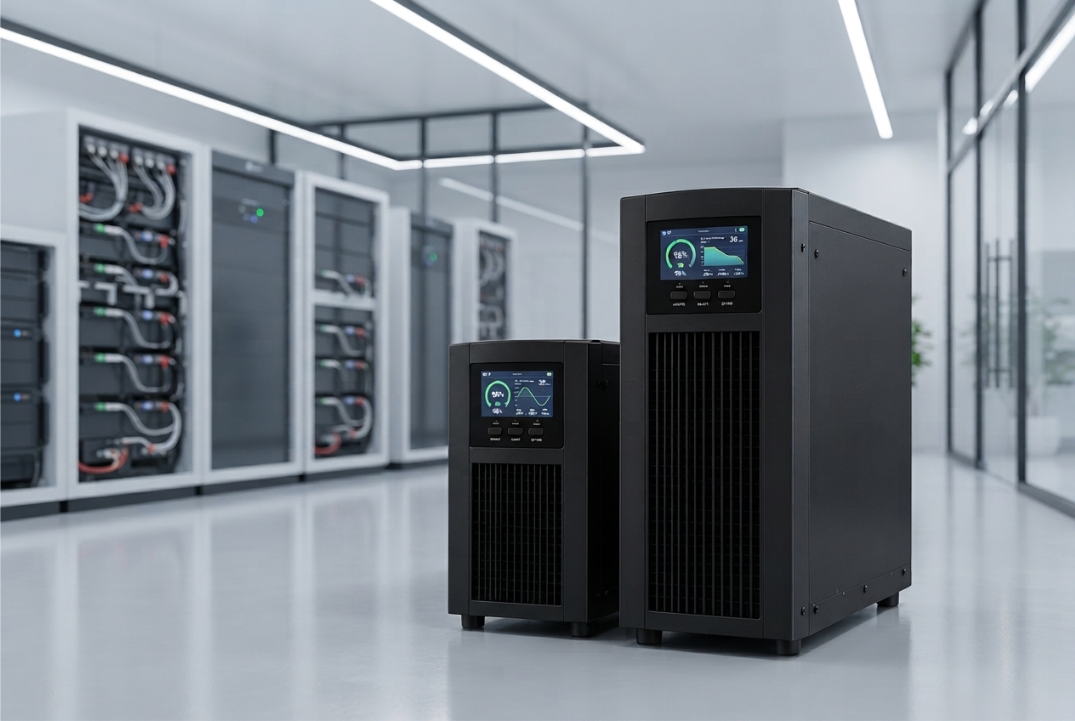
A clean, professional image showing multiple 3-phase UPS units installed in a data center environment — without text, showcasing the modern infrastructure.
Internal Image Suggestions
- Power flow diagram comparing single vs three-phase.
- Close-up of modular UPS system with battery packs.
- Infographic showing 5 key reasons visually (Efficiency, Scalability, Reliability, Power Quality, TCO).
- Technician monitoring UPS dashboard.
- Green energy icon showing efficiency and sustainability.
Conclusion
The demand for uninterrupted, reliable, and efficient power in data centers and server rooms has never been higher.
A 3-phase UPS system ensures not only continuous power supply but also delivers better efficiency, scalability, and long-term cost benefits for growing IT environments.
With the rapid pace of digital transformation, rising energy costs, and the increasing dependence on critical IT systems, choosing a 3-phase UPS isn’t just a technical decision — it’s a strategic investment that safeguards your organization’s operations, data, and reputation.
If you’re managing or designing a data center, upgrading to a 3-phase UPS is one of the smartest steps you can take to guarantee business continuity, data security, and operational excellence — with trusted solutions from Bansal Hitech Systems Private Limited.