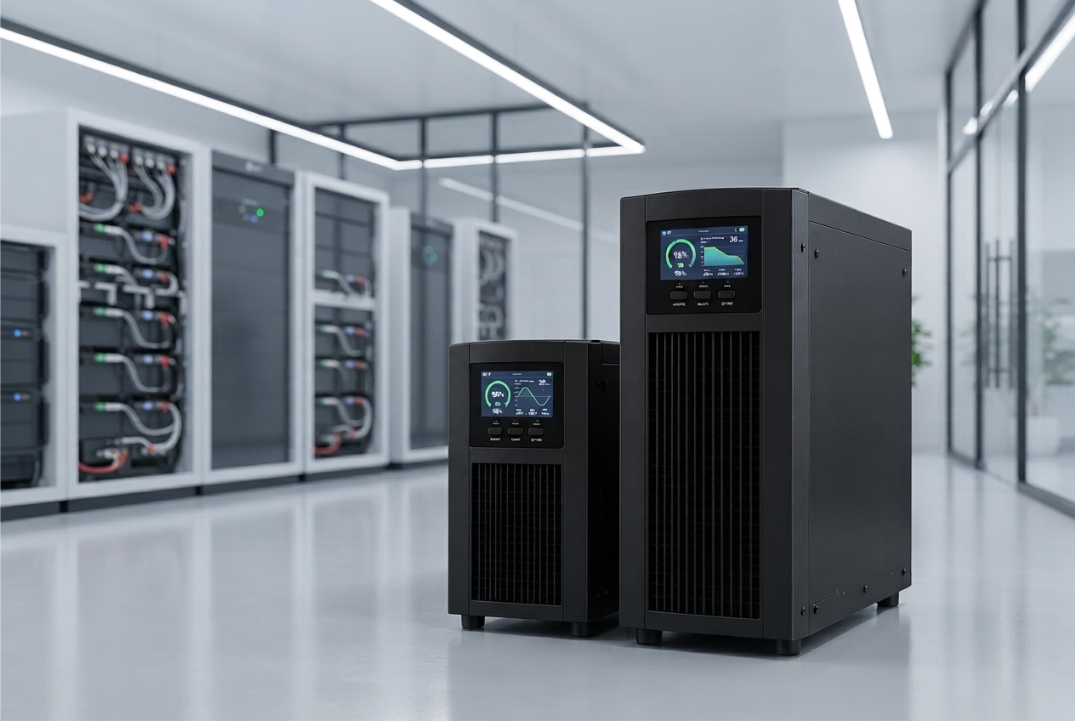

Data centres support essential digital services, business applications, cloud platforms, databases, and enterprise IT infrastructure. These environments require stable power to keep servers, storage systems, networking equipment, and monitoring platforms operational. Even a brief power interruption can disrupt workloads, interrupt data access, or affect service availability.
A 3 Phase Online UPS for Data Center Reliability helps protect critical IT loads against power interruptions and many common electrical disturbances. When properly sized and maintained, it can also provide time for backup power systems to take over or for IT equipment to shut down safely.
However, data centre reliability depends on more than a UPS. Battery health, electrical distribution, cooling, redundancy, monitoring, and maintenance all contribute to overall resilience. This guide explains nine important ways a three-phase online UPS can support data centre operations.
What Is a 3 Phase Online UPS for Data Center Reliability?
A three-phase online UPS is a power protection system designed to supply compatible equipment through a continuously operating conversion process. In a typical double-conversion design, incoming AC power is converted to DC and then converted back to AC. This helps isolate connected equipment from many common input-power disturbances.
A 3 Phase Online UPS for Data Center Reliability can support critical server rooms, enterprise data centres, and IT infrastructure with substantial power requirements. Depending on the design, it may protect server racks, storage equipment, network devices, and other essential loads.
Organisations can explore three-phase online UPS solutions to assess the available options for their power protection requirements.
9 Critical Ways a 3 Phase Online UPS Ensures Data Center Reliability
1. Maintains Power During Electrical Interruptions
Data centres depend on continuous power to keep applications, databases, and connected services available. A sudden power failure can interrupt workloads and affect users who rely on those services.
A suitably configured UPS provides temporary battery power when its incoming supply fails. This bridge can keep supported IT loads running while a generator or another backup source becomes available, provided the system has been designed for that transition.
The required runtime depends on the backup architecture, load demand, battery configuration, and generator transfer arrangements. Therefore, data centre operators should calculate the necessary runtime rather than assume every UPS installation provides the same duration.
For general power protection requirements, operators can review online UPS systems and compare them against their facility’s operational needs.
2. Protects Servers and Storage Infrastructure
Servers and storage systems host business applications, virtual machines, databases, and essential files. An unexpected shutdown can interrupt active workloads and create recovery tasks for IT administrators.
A properly sized UPS can keep compatible servers, storage arrays, and supporting equipment operational during short interruptions. If an outage continues, shutdown software can help administrators stop selected workloads and equipment in a controlled sequence.
The UPS must support both the real power demand in kilowatts (kW) and the apparent power demand in kilovolt-amperes (kVA), within its specified limits. Operators should also account for load changes and future capacity requirements.
For broader infrastructure planning, data centre solutions can help organisations evaluate related requirements alongside power protection.
3. Reduces the Impact of Common Power Disturbances
Power disturbances can include voltage fluctuations, electrical noise, and certain input-supply irregularities. These events may affect sensitive IT equipment, particularly when the electrical infrastructure is poorly designed or inadequately maintained.
Online double-conversion UPS technology helps regulate the output supplied to connected equipment and reduces the impact of many common input-power disturbances. This supports a more controlled power environment for compatible servers and networking devices.
However, a UPS does not eliminate every electrical risk. Proper grounding, circuit protection, distribution design, and compliance with equipment requirements remain essential.
Data centre teams should evaluate the HPI 33 EVO 10–40 kW three-phase UPS against verified product specifications when considering a suitable configuration.
4. Supports Network Availability and Connectivity
Network switches, routers, firewalls, and other communication devices connect servers to users, applications, and external services. If these devices lose power, systems may become unreachable even when some servers remain operational.
A UPS can protect compatible networking equipment and help maintain connectivity during short power interruptions. This can be particularly important in environments where internal applications and external services depend on shared network infrastructure.
Operators should identify the network components that must remain powered and include them in the critical-load calculation. They should also consider the availability of upstream network services and telecommunications links.
Organisations can review networking and IT infrastructure when assessing the supporting systems needed for dependable connectivity.
5. Enables Controlled Shutdowns and Recovery
Not every power failure can be resolved before the UPS battery reaches its operating limit. When an outage lasts too long, data centre teams need a safe and predictable shutdown process.
A UPS can provide time for monitoring systems and shutdown software to initiate predefined actions. Depending on the configuration, these actions may include saving application state, stopping workloads, closing databases, and shutting down selected servers.
A controlled shutdown can reduce the risk of interrupted writes and avoidable recovery work. Nevertheless, the UPS must be integrated with compatible management software, and shutdown procedures should be tested regularly.
For broader IT planning, IT infrastructure solutions can be considered alongside the power protection strategy.
6. Supports Redundancy and High-Availability Designs
Data centres often use redundancy to reduce the impact of equipment failure or scheduled maintenance. Depending on their requirements, operators may use parallel UPS modules, redundant power paths, or separate protected distribution arrangements.
A three-phase UPS can form part of such a design when its configuration supports the intended redundancy strategy. However, installing multiple UPS units does not automatically create a redundant system. The electrical paths, maintenance bypasses, distribution panels, and connected equipment must all be designed appropriately.
Operators should also consider whether server power supplies connect to separate power paths and whether each path can carry the required load independently.
For larger critical loads, the Keor HPE 60–500 kW three-phase UPS range may be evaluated against verified capacity and configuration requirements.
7. Improves Power Management and Operational Visibility
Modern data centres need clear information about electrical demand, battery condition, alarms, and system status. Without appropriate monitoring, an emerging power issue may remain unnoticed until it affects operations.
Depending on the model and installation, a UPS may provide monitoring features, alarm notifications, and status information that help technical teams assess its condition. Integration with a wider building or infrastructure monitoring platform may also improve operational visibility.
However, monitoring capabilities vary between products. Data centre operators should confirm the available interfaces, supported protocols, management software, and alerting functions before making a selection.
A complete monitoring plan should also include regular inspections, battery testing, alarm response procedures, and maintenance records.
8. Helps Protect Critical Business Applications
Data centres support systems such as customer platforms, payment services, enterprise software, cloud applications, and internal databases. Power interruptions affecting these systems can disrupt business processes and reduce service availability.
By keeping supported IT equipment powered during short outages, a UPS can help reduce the risk of unplanned interruptions. It also gives administrators time to initiate shutdown or failover procedures when required.
Nevertheless, a UPS alone cannot guarantee application availability. Reliable services also depend on server redundancy, software resilience, data replication, network architecture, and tested disaster recovery plans.
Organisations should assess the entire service chain rather than focus only on the UPS capacity.
9. Supports Future Data Centre Expansion
As organisations add servers, storage, networking devices, or new applications, their power requirements can increase. A UPS selected without room for growth may become a constraint or require premature replacement.
Capacity planning should account for current demand, expected expansion, redundancy, power factor, battery runtime, and the distribution of loads across phases. Operators should also verify whether the selected UPS supports the intended expansion method.
For applications that need a modular design, Easy UPS 3-Phase Modular 50–250 kW may be worth evaluating against current specifications and the data centre’s load profile.
How to Choose the Right Three-Phase UPS for a Data Centre
Selecting a UPS requires a detailed assessment of the electrical and operational environment.
Calculate the Critical Load
Identify which servers, storage systems, networking devices, and monitoring components require backup power. Calculate their actual power demand and include reasonable headroom for load changes and future growth.
The UPS must support both kW and kVA requirements within its ratings. Avoid sizing the system solely from the number of server racks or the total equipment count.
Determine the Required Runtime
Establish how long the UPS must support the critical load. The target may be based on generator start-up and transfer time, operational requirements, or the time needed for a controlled shutdown.
Battery runtime varies with load, battery configuration, battery condition, temperature, and operating conditions. Use manufacturer data or a qualified sizing assessment to confirm the expected performance.
Evaluate Redundancy Requirements
Decide whether the facility needs a single UPS system, parallel capacity, redundant modules, or separate power paths. The appropriate architecture depends on the consequences of downtime and the facility’s reliability objectives.
A design review should include maintenance bypasses and procedures for servicing equipment without unnecessarily interrupting protected loads.
Check Monitoring and Maintenance Features
Confirm the UPS’s monitoring interfaces, alarm functions, battery management capabilities, and maintenance requirements. Establish a schedule for inspection, battery testing, and preventive servicing.
For some organisations, online UPS rental services may be worth considering for temporary requirements or evaluation purposes, subject to availability, contract terms, and technical suitability.
Three-Phase Online UPS vs. Other Power Protection Options
Different power protection arrangements serve different purposes. A three-phase online UPS is not a replacement for every element of a data centre’s electrical infrastructure.
| Power protection option | Primary role | Important consideration |
|---|---|---|
| Three-phase online UPS | Provides temporary power and conditions the supply to compatible critical loads | Must be sized for kW, kVA, runtime, and redundancy |
| Standby generator | Provides longer-duration backup when properly configured and supplied with fuel | Requires start-up and transfer arrangements |
| Surge protection | Helps protect against specified transient overvoltage events | Does not provide battery backup |
| Redundant power distribution | Provides alternative electrical paths where properly designed | Requires compatible equipment and careful path separation |
| Data backup and replication | Helps protect data and support recovery | Does not maintain electrical power |
For dependable data centre operations, these measures should work together as part of a coordinated resilience strategy.
Why Consider Bansal Hi-Tech for Data Centre Power Protection?
Data centre operators need power protection that reflects their IT load, uptime objectives, infrastructure design, and maintenance requirements. Bansal Hi-Tech offers power-related products and IT infrastructure solutions that organisations can evaluate during the planning process.
A suitable assessment should begin with the critical-load inventory, required battery runtime, redundancy architecture, and equipment compatibility. The selected product must then be checked against current manufacturer specifications and installation requirements.
Organisations can explore three-phase online UPS options and IT infrastructure accessories as part of their wider planning. Product availability, technical specifications, and service arrangements should be confirmed directly before purchasing.
Frequently Asked Questions
1. Why is a three-phase online UPS important for data centres?
It can provide temporary power to compatible critical IT loads during an interruption and help reduce the impact of common input-power disturbances. Its role depends on the system design, connected equipment, and required runtime.
2. Can a UPS guarantee uninterrupted data centre operations?
No. A UPS is one component of a broader reliability strategy. Overall availability also depends on redundancy, generators, electrical distribution, cooling, maintenance, networking, and application-level resilience.
3. How long can a three-phase UPS support data centre equipment?
The runtime depends on the UPS model, battery configuration, connected load, battery condition, and operating environment. Data centre operators should confirm runtime at the expected load rather than rely on a general estimate.
4. Can a UPS protect servers and storage systems?
Yes, when the equipment is compatible and the UPS is correctly sized. It can provide temporary power during short outages and allow a controlled shutdown if the interruption continues.
5. Is a generator still necessary if a data centre has a UPS?
A UPS and generator often perform complementary roles. The UPS provides immediate temporary power within its design limits, while a suitably sized generator can support longer outages after starting and transferring the load.
6. What is the difference between a three-phase UPS and a single-phase UPS?
A three-phase UPS is generally used for larger loads or infrastructure designed for three-phase power. A single-phase UPS may be suitable for individual servers, workstations, or smaller equipment. The correct option depends on the load and electrical design.
7. How often should a data centre UPS be maintained?
Maintenance frequency depends on the manufacturer’s recommendations, battery technology, operating conditions, and service requirements. Facilities should follow a documented inspection and testing schedule and address alarms promptly.
Conclusion
A 3 Phase Online UPS for Data Center Reliability can help maintain power to selected servers, storage systems, networking equipment, and other critical IT loads during electrical interruptions. It can also support controlled shutdowns, power quality management, and wider redundancy strategies when properly integrated into the facility’s design.
Reliable data centre operations require a coordinated approach to power, monitoring, maintenance, and recovery. By evaluating actual loads, battery runtime, redundancy, and future capacity, organisations can select a UPS configuration that aligns with their operational needs. Bansal Hi-Tech can be considered as part of that evaluation, subject to verification of product specifications and installation requirements.