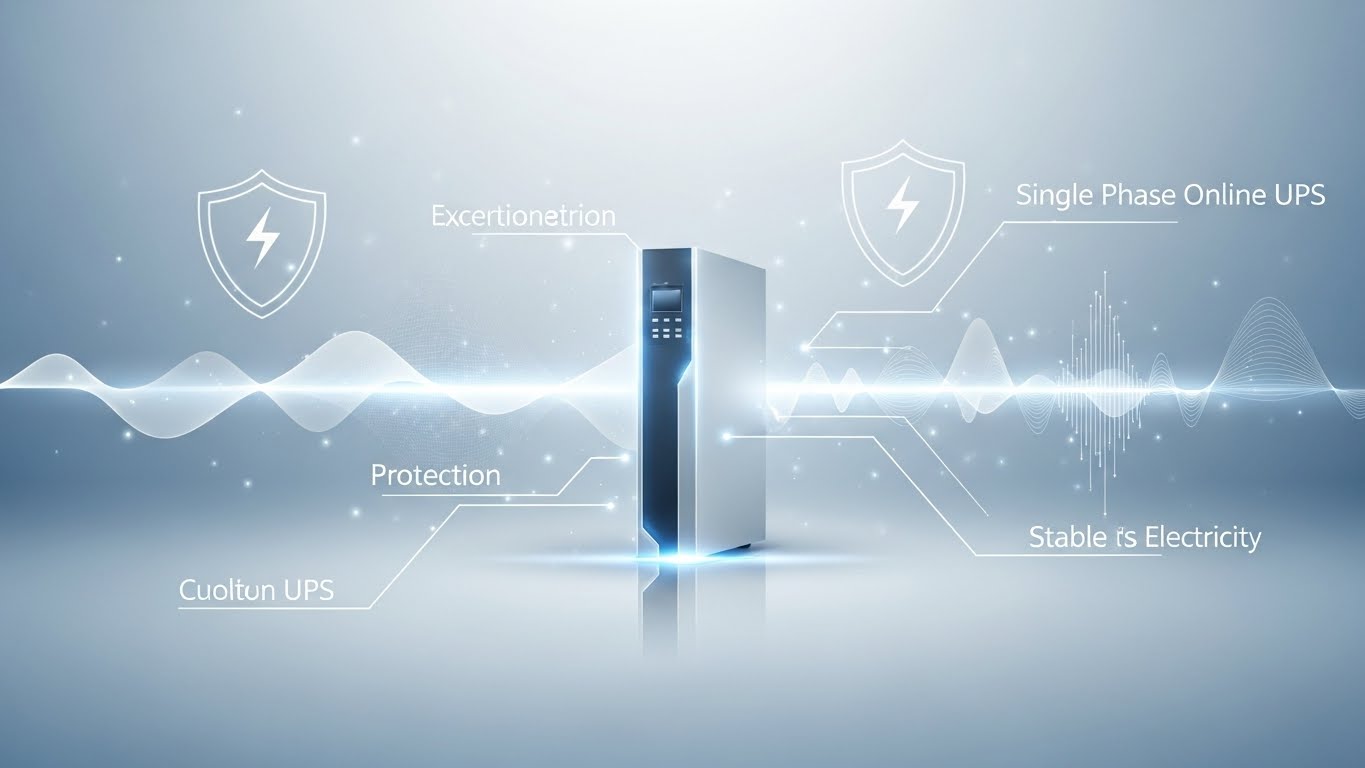
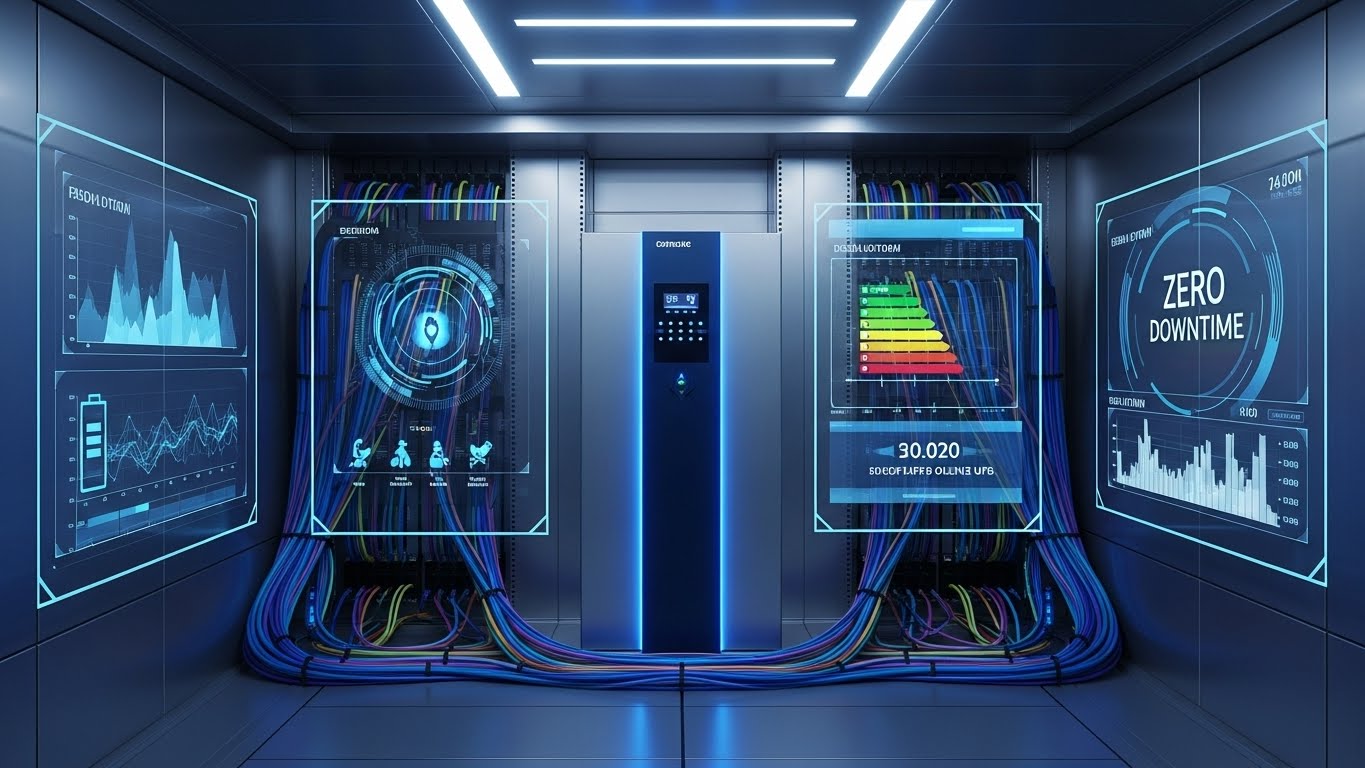
Ensuring zero downtime is a critical goal for any organization that relies on continuous power. Single-phase online UPS systems play a major role in protecting sensitive equipment from outages, spikes, and fluctuations. To achieve maximum reliability, decision-makers must understand the 10 Single Phase Online UPS Performance Factors That Ensure Zero Downtime. These factors determine stability, efficiency, and long-term performance.
These factors help IT teams, industrial users, data centers, SMEs, and home-office setups select the right UPS. This article explains each performance factor in simple language. It highlights trade-offs, challenges, and decision-making concerns. It also covers why keeping these Single Phase Online UPS Performance Factors in mind helps users avoid operational risks.
1. Power Conversion Efficiency: A Core Single Phase Online UPS Performance Factor
Efficiency shows how well a UPS converts input energy into clean output power. Higher efficiency reduces heat, saves power, and increases reliability.
A system with 95–98% efficiency is ideal. High efficiency cuts electricity bills, but users must balance this with load type and runtime requirements.
Challenges:
- Efficiency may drop with very low or very high loads.
- Some ultra-efficient UPS units may cost more upfront.
Internal Link: Explore advanced UPS ranges here:
https://bansalhitech.com/ups/
2. Battery Health and Backup Time
Batteries determine the UPS runtime during outages. Healthy batteries ensure smooth failover and zero interruption.
Key considerations include:
- Battery type (SMF, Lithium-ion, Tubular)
- Charging technology
- Temperature
- Discharge cycles
Trade-off: Longer backup time requires larger batteries, increasing cost and space.
Modern UPS systems use smart battery management to extend life and improve performance.
Internal Link: Learn about high-quality UPS battery solutions:
https://bansalhitech.com/product/ups-systems-batteries/
3. Transfer Time and Double-Conversion Performance
Single-phase online UPS technology offers zero transfer time. This makes it ideal for critical systems like servers, labs, and telecom devices.
Double-conversion mode stabilizes output voltage and frequency. It eliminates spikes, surges, sags, and noise.
Why it matters:
- Protects delicate electronics
- Provides clean and conditioned power
- Ensures stable operation during fluctuating grid conditions
The challenge is energy consumption because double-conversion units run continuously.
4. Load Handling Capacity (kVA Rating)
Choosing the correct load capacity prevents overloads and enhances safety. A UPS should support at least 20–30% extra headroom above the actual load.
Under-sizing causes:
- Overheating
- Frequent shutdowns
- Reduced lifespan
Over-sizing increases cost and power use.
Right-sizing is a core Single Phase Online UPS Performance Factor for long-term stability.
5. Input and Output Power Factor Correction
A high power factor allows the UPS to handle more real load. Many modern UPS units provide unity power factor (1.0 PF), increasing usable capacity.
Benefits include:
- Better equipment compatibility
- Reduced energy loss
- Improved performance during fluctuating voltage
Older UPS models have low PF, reducing actual usable power.
6. Heat Dissipation and Cooling Efficiency
Cooling affects UPS life and efficiency. Heat reduces battery life and stresses internal components.
Good UPS designs include:
- Proper heat sinks
- Smart fan control
- Thermal sensors
- Ventilation channels
You must maintain environmental temperature between 20°C–25°C for ideal performance.
Trade-off: Superior cooling systems increase UPS size and cost.
7. THD (Total Harmonic Distortion) Control
THD measures distortion in output voltage waveform. Lower THD ensures cleaner power.
Modern single-phase online UPS systems deliver <3% THD.
Why THD matters:
- Prevents overheating in connected devices
- Ensures accurate functioning of medical and IT equipment
- Reduces electromagnetic interference (EMI)
Challenges arise when operating cheap electronics or inductive loads that increase distortion.
8. Surge Protection and Voltage Regulation
A top Single Phase Online UPS Performance Factor is its ability to protect against surges. Voltage instability is common in many regions. A UPS must regulate output voltage within ±1–2%.
Important features:
- AVR (Automatic Voltage Regulation)
- Surge suppression circuits
- Spike filters
Trade-off: Advanced surge protection systems cost slightly more but prevent thousands in equipment damage.
9. Remote Monitoring and Management Tools
Smart UPS systems support IoT monitoring, SNMP cards, mobile alerts, and dashboards.
Remote monitoring helps users:
- Track battery status
- Check temperature
- Monitor load
- Receive fault alerts
- Perform preventive maintenance
Challenges include setup complexity and network configuration needs.
Internal Link: Learn more about advanced solutions Bansal Hi Tech offers:
https://bansalhitech.com/services/
10. Build Quality, Brand Reliability, and Service Support
The final and perhaps most important performance factor is the brand’s engineering quality, service coverage, and support network.
Good UPS systems offer:
- Strong internal PCB layout
- High-quality IGBT modules
- Stable firmware
- Protection layers for overload, short circuit, and overheating
Service accessibility matters. Fast repairs and on-site support reduce downtime.
Users must consider:
- Warranty terms
- Service centre availability
- Spare parts access
- After-sales support ratings
Internal Link: Explore support options here:
https://bansalhitech.com/contact/
Understanding the Balance: Trade-Offs in Single Phase Online UPS Performance
Every UPS setup involves trade-offs. Here are examples:
| Factor | Trade-Off |
|---|---|
| Higher efficiency | Lower heat but may increase cost |
| Larger batteries | Longer backup but more space and weight |
| Zero transfer time | Better protection but more power consumption |
| High power factor | Improved load support but requires advanced circuits |
| Superior build quality | Increased upfront cost |
Balancing these trade-offs ensures optimized UPS performance.
Why These 10 Single Phase Online UPS Performance Factors Matter
These factors determine how well the UPS handles emergencies and power fluctuations. They impact:
- Business continuity
- Operational cost
- Equipment health
- Safety
- Productivity
Keeping these Single Phase Online UPS Performance Factors in mind helps organizations plan better and reduce failure risks.
How to Evaluate a Single-Phase Online UPS for Zero Downtime
Here is a simple checklist:
- Check efficiency rating (95%+ recommended).
- Choose battery backup based on your needs.
- Confirm zero transfer time.
- Select appropriate load capacity (with extra headroom).
- Look for unity power factor.
- Ensure good thermal management.
- Verify THD levels (<3%).
- Confirm voltage regulation accuracy.
- Request remote monitoring features.
- Consider brand reputation and support.
Future Trends in Single Phase Online UPS Performance
Technology continues to evolve. Future UPS systems may include:
- AI-based load prediction
- Automatic efficiency optimization
- Lithium-ion and solid-state batteries
- Blockchain-backed service logs
- Advanced IoT-based UPS clusters
These innovations will improve reliability and simplify management.
Conclusion
The 10 Single Phase Online UPS Performance Factors That Ensure Zero Downtime help industry leaders, IT managers, and operational teams choose the right UPS with confidence. Understanding these factors reduces risk, improves stability, and ensures that operations run smoothly without interruption.
By considering efficiency, battery systems, regulation features, monitoring tools, and support networks, users can build a strong power protection strategy. Zero downtime is possible when every element of the UPS system works together with precision.
If you need help selecting the right UPS for your applications, explore professional solutions at:
https://bansalhitech.com/